Skip to content

Singing and guitar, online

Your voice can be trained, too.

Build a stronger voice, sing with more feeling and enjoy every song. Start with 10 free minutes a day, and play along on guitar, free too.

Try the free warm-up

Free forever: 10 minutes a day plus guitar. No credit card. How it works

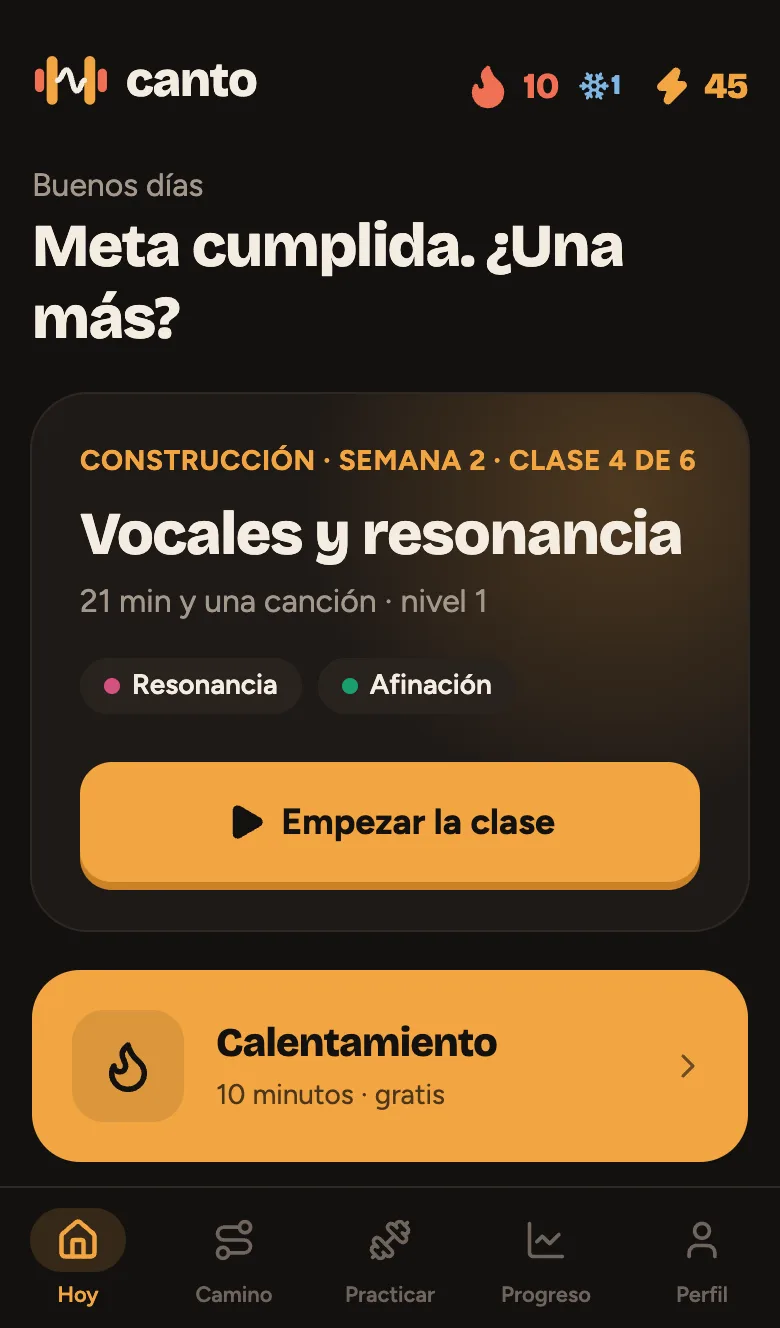
A woman sings in her living room, eyes closed, one hand on her chest Juglar on a phone: today's workout

What changes in your voice

You'll feel it.
And you'll see it.

01

Sing in tune with the note right in front of you.

Singing in tune is mostly about connecting what you hear to what your voice does. As you sing, you see your voice on top of the note: sharp, flat or spot on stops being a hunch. You see it, you adjust, and with practice you start to feel the note without looking.

Note: A4 In tune ✓
You start singingYou lock onto the note

02

Reach higher and lower, without straining.

Much of your range is coordination: going higher without your voice cracking as it shifts from chest voice to head voice. The exercises work on that shift within your range, and every week you complete takes you a little further. Every four weeks you measure it again and see how much it has grown.

Your range · example

Week 16

F3 – G5

03

Hold notes longer.

Every workout measures your long note: how many seconds you hold it in tune. Week by week, you watch the number grow. Real progress, not a feeling.

Your long note · example

12.4 s

Example: the long note grows from 4.2 seconds in week 1 to 12.4 in week 8.

Try it today: the 10-minute warm-up is free.

Try the free warm-up

The program

Just like the gym: the load goes up, and rest locks it in.

The first weeks use trills and closed vowels, the kindest on your voice; the open “ah” comes once the coordination is there. Each week asks a little more: more sets, more range, faster scales. Every fourth week is a deload week, so your training can sink in. And if your voice ends up tired, your next workout goes lighter.

Weekly load · example

Deload week

Foundation
Week 1

Build
Weeks 2–8

Growth
Weeks 9–16

Advanced
Week 17 and up

  1. Warm up · 10 min

    Breathing, lip trills, humming, straw and sirens. The piano guides you through your range.

  2. Train · 20–30 min

    Today's workout, with one focus: support, range, vowels or agility.

  3. Play · anytime

    Play along on guitar: notation and tab that play back, at your tempo, with a metronome.

You work all 5 voice muscles: Support Range Pitch Agility Resonance

Week 1 is free. Start today.

Try the free warm-up

Hooks you like a game

Coming back tomorrow is what moves you forward most.

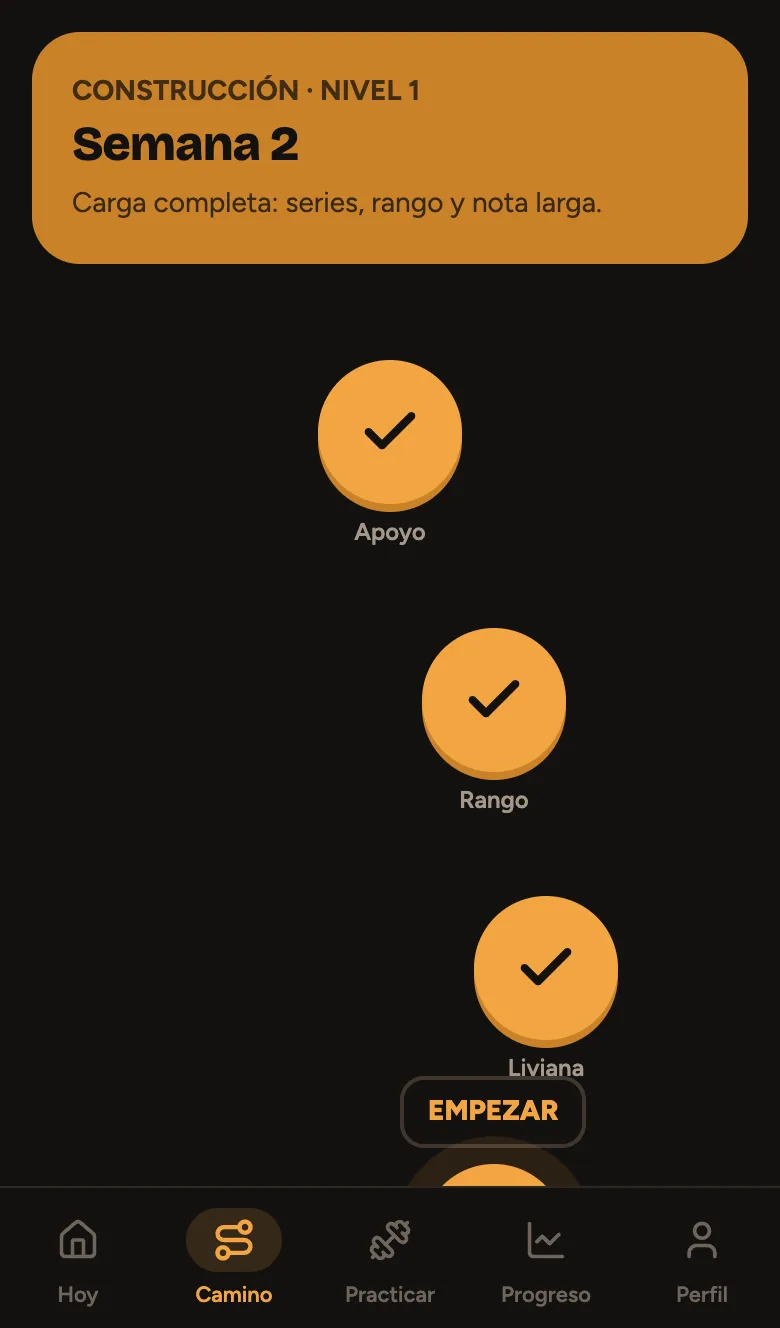
  • Your path. Every workout is a stop; every week, a unit. You always know what's next.

  • Streak and daily goal. Every 7 days in a row earns you a streak freeze that protects your streak.

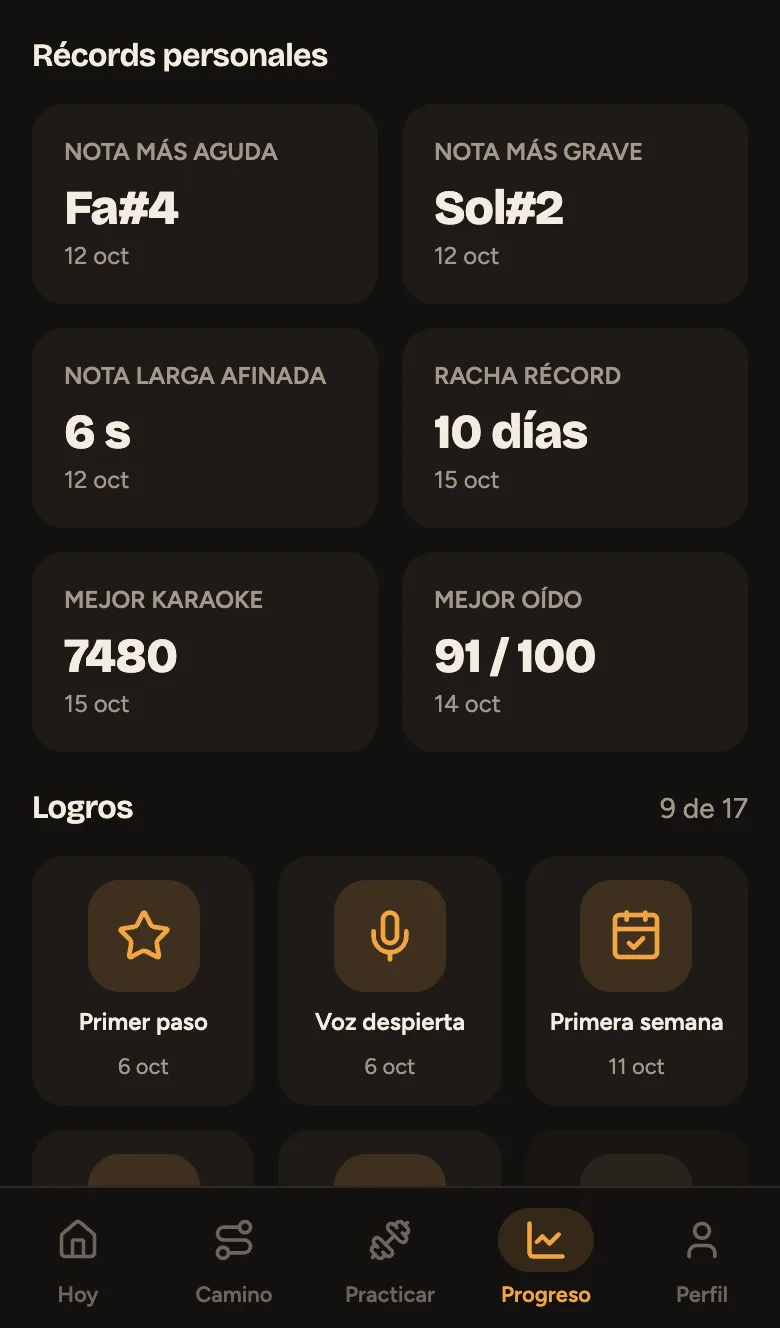
  • XP, achievements and bests. Your highest note, your lowest note, and your longest long note.

  • On your phone and your computer. All you need is a mic. No account: your progress stays on your device.

The workout path, week by week Personal bests and achievements

The science behind it

We didn't make it up. We built it on what the research says.

Studies published in Journal of Voice · Journal of the Acoustical Society of America · Psychology of Music · Journal of Speech, Language, and Hearing Research · Medicine & Science in Sports & Exercise

You probably sing more in tune than you think.

In a study of 62 occasional singers, only a minority made a lot of pitch errors. When fifteen of them sang the song again at a slow tempo, most sang about as accurately as professional singers.

Dalla Bella, Giguère and Peretz · J. Acoust. Soc. Am., 2007 ↗

1 in 3

Of three training methods for adults who struggle to sing in tune, only the one with visual feedback led to significant improvement.

That's why you see your voice in every exercise.

Berglin et al. · Psychology of Music, 2022 ↗

4

weeks of specific vocal exercises extended the range and lengthened the held notes of women with healthy voices. The placebo and control groups didn't change.

That's why every workout trains something specific, not just singing.

Stemple et al. · J. Voice, 1994 ↗

90%

of vocal recovery came 4 to 6 hours after two hours of reading aloud. Full recovery took 12 to 18.

That's why there are light days and a rest day.

Hunter and Titze · Ann. Otol. Rhinol. Laryngol., 2009 ↗

137

systematic reviews back the American College of Sports Medicine's recommendation: train progressively.

That's why each week asks a little more.

Currier et al. · Med. Sci. Sports Exerc., 2026 ↗

Juglar applies these principles to singing. It isn't a treatment and doesn't replace a voice professional.

Read the evidence on the blog →

Pricing

Start free. Go further when you're ready.

Free

Train every day without paying a thing.

USD 0

  • ✓ Guided 10-minute warm-up
  • ✓ Guitar: notation and tab that play back
  • ✓ Real-time tuner
  • ✓ Range finder and ear training
  • ✓ The first week of the program
  • ✓ Streaks, XP and achievements
Start free
Recommended

Premium

The full program, leveling up with you.

USD 5 / month

USD 60 a year

  • ✓ Everything in Free
  • ✓ A different workout every day, 20 to 30 minutes
  • ✓ Weekly progression: more sets, more range, longer notes
  • ✓ Workouts that adapt when your voice ends up tired
  • ✓ The full path: Foundation, Build, Growth, Advanced
  • ✓ On the web, on Android and on iPhone
Try the program

The program's first week is free. Secure payment with Stripe.

Frequently asked questions

Do I need to know how to sing?+

No. Before your first workout you measure your range, and everything fits it. The first week lays the groundwork with a light load, trills and closed vowels, so you learn the exercises without straining. If you already sing, the program quickly catches up to your level.

What changes in my voice when I train?+

Coordination comes first: you learn to connect what you hear to what your voice does, and to shift from chest voice to head voice without cracking. Over the weeks, the muscles of your breathing and your larynx adapt too. What doesn't “get stronger” is the vibrating mucosa: that needs looking after, which is why there are light days.

How much time a day?+

The warm-up takes 10 minutes. Program workouts take 20 to 30. You pick your daily goal: easy, regular or intense.

What do I need?+

A phone or computer with a mic, and a place where you can sing. Your guitar, for guitar. For the warm-up, a straw and some water.

Does it work on iPhone?+

Yes: Juglar has an iPhone app on the App Store. It also works in Safari, and on Android, Windows and Mac.

Is there an Android app?+

Yes, and you don't need the Play Store. In Chrome, tap “Install app” (up top or in your profile inside Juglar), or open the ⋮ menu and pick Install app. It sits on your home screen like any other app.

Can I cancel Premium?+

Anytime, from your profile, in two clicks. You keep Premium until the end of the period you paid for, and your progress stays saved.

Is it safe for my voice?+

The program is designed so your voice finishes better than it started: it builds up gradually, mixes in light days and lowers the load if you end up tired. It doesn't replace a professional: if hoarseness lasts more than two weeks, see an ENT or a speech-language pathologist.

Your voice, a little better every day.

Start today with the 10-minute warm-up. It's free.

Try the free warm-up

Install Juglar on your iPhone

  1. 1Tap Share (the square with the arrow) at the bottom of Safari.
  2. 2Choose “Add to Home Screen”, then tap “Add”.
  3. 3Open Juglar from your Home Screen, like any app.